“A Justice Worthy of the Title”
Book Review: Justice, Justice Thou Shalt Pursue: A Life’s Work Fighting for a More Perfect Union, by Ruth Bader Ginsburg & Amanda L. Tyler (UC Press, 2021)
Reviewed by Dean C. Rowan
At the end of her life Ruth Bader Ginsburg was a celebrity jurist and feminist, the subject of a full-scale opera, and a cultural “meme” that parodies the name of a famous rap artist. To say the least, hers was an anomalous, even extraordinary, reputation. Yet it’s a fair guess that relatively few who acknowledged her notoriety ever actually read her legal writings. Justice, Justice Thou Shalt Pursue: A Life’s Work Fighting for a More Perfect Union should remedy that circumstance, because it consists primarily of such writings presented as integral to her life, philosophy, and personality. It is Justice Ginsburg’s final book, published not long after her death in fall of 2020.
Her co-author is Professor Amanda L. Tyler of UC Berkeley School of Law. Prof. Tyler clerked for Justice Ginsburg at the Supreme Court during the 1999 term, and they remained friends thereafter.
Four sections comprise the book’s core, devoted in turn to Ginsburg’s tribute to her late friend and colleague, beloved Berkeley Law professor and dean Herma Hill Kay; Ginsburg’s work as an attorney; her tenure as an associate justice of the Supreme Court; and speeches she delivered in recent years. The texts were chosen by Ginsburg and Tyler. Prof. Tyler’s contributions bookend the volume and introduce each section and constituent texts. A range of photographs depict Ginsburg’s academic, domestic, and professional experiences, achievements, and milestones.
Prof. Tyler introduces the book as a window into the variety of aspects of Ginsburg’s life, as indeed it is, yet it also depicts a unity of ambition and purpose. It is an account of “a life’s work” that exposes the reader to texts rich in learned, heartfelt legal argument and rhetoric, and renders the connections between personal experience and jurisprudence. In this respect, Justice, Justice Thou Shalt Pursue is similar to a recent biography of the Justice, Victoria Ortiz’s Dissenter on the Bench: Ruth Bader Ginsburg’s Life & Work (Clarion Books, 2019). Writing for young adult readers, Ortiz emphasizes the ways in which life informs work, and thus the two books neatly complement each other. One will turn to Ginsburg and Tyler for a cento of Ginsburg’s influential legal writing, to Ortiz for more biographical detail and narrative.
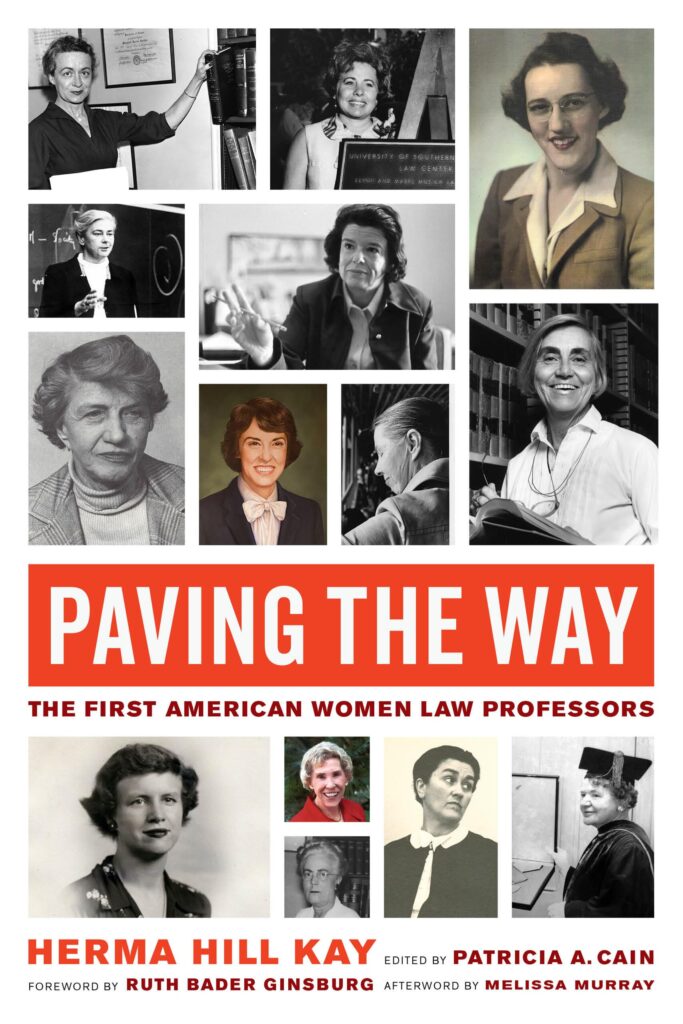
The transcriptions in the first section, a tribute by Ginsburg followed by her conversation with Prof. Tyler on the Berkeley campus, were prompted by the death in 2017 of Kay, among the first tenured American women law professors, and a scholar whose work advanced sex and gender discrimination law, family law, and conflict of laws. Kay and Ginsburg co-wrote the first sex-based discrimination casebook. They were enduring friends, and so it was apt for Ginsburg to inaugurate the Herma Hill Kay Memorial Lecture series on the Berkeley campus in October of 2019. (The delay was due to Ginsburg’s unexpected surgery in 2018.)
The second section consists of three examples of Ginsburg’s work as an attorney, a brief and transcripts of two oral arguments from three cases in which she successfully represented plaintiffs: Moritz v. Commissioner of Internal Revenue, Frontiero v. Richardson, and Weinberger v. Wiesenfeld. Famously, Ginsburg delivered the Frontiero oral argument for eleven minutes without interruption from the Supreme Court justices. Here emerges a vein of irony that courses through the book, affording a lesson in litigation strategy and policy advocacy, for in each case the feminist Ginsburg challenged laws that on their face were detrimental to males vis-à-vis similarly situated females. But Ginsburg understood that the principle of gender equity cuts both ways, moreover that discriminatory laws are likely to harm others beyond their ostensive scope. Thus in Wiesenfeld the Court held unconstitutional the denial of a Social Security death benefit to a surviving husband who had sole responsibility for the couple’s infant child. Surely the child was also harmed by the denial of benefits to his father. Prof. Tyler highlights where Ginsburg’s advocacy in court so often challenged patriarchal and misogynist economic, social, and legal norms that handicapped her own experiences as a woman, mother, and spouse. For example, despite the fact that she graduated at the top of her class at Columbia, to which she’d transferred from Harvard, she encountered difficulties finding employment as an attorney.
A selection of bench announcements, a majority opinion, and, significantly, three dissenting opinions from her tenure on the Supreme Court, comprise section three, the most extensive and perhaps the most compelling, not least because Ginsburg deemed the opinions her favorite. It commences with Herma Hill Kay’s prepared statement before the Senate Judiciary Committee hearings on Ginsburg’s nomination to the Court in July of 1993. “I speak today not only as an academic observer of Judge Ginsburg’s work, but also as her co-author and friend,” remarks Kay, illustrating the interwoven aspects of Ginsburg’s life as they culminated in a national, legal, and personal milestone. (The title of this review is another of Kay’s remarks at the hearing.) The cases are all indisputably landmarks: United States v. Virginia, Ledbetter v. Goodyear Tire & Rubber Co., Shelby County v. Holder, and Burwell v. Hobby Lobby Stores, Inc. These cases involved voting rights and race-based as well as sex-based discrimination. Though one might have preferred a broader representation of her jurisprudence in lieu of bench announcements and opinions for each case, the former register Ginsburg’s fervent sense of justice and, where she dissents, injustice respecting the cases. The opinions and their brief announcements share the same message, but in the announcements Ginsburg conveys moral commitments that a full judicial opinion ordinarily relegates to the background.
Three speeches delivered in 2016 and 2018 comprise the fourth section and fittingly encapsulate Ginsburg’s judicial vision of incremental progress toward justice. The first, an account of lessons learned from the legacy of Louis D. Brandeis’ work as an advocate and Supreme Court justice, taps again into the vein of irony, for while Ginsburg didn’t agree with the substance of Brandeis’ views, she admired and respected his litigation strategies, and deployed them in pursuit of her preferred outcomes. In the second speech, in which she accepts a Genesis Prize in Tel Aviv, Ginsburg movingly draws on her heritage as a Jew and her religious inspirations. “I am a judge,” she writes, “born, raised, and proud of being a Jew. The demand for justice, for peace, and for enlightenment runs through the entirety of Jewish history and Jewish tradition.” In the concluding speech at a naturalization ceremony, Ginsburg promotes work toward a more perfect union in light of the fact that “the work of perfection is scarcely done.”
Prof. Tyler’s multiple contributions, including her afterword prepared in response to the news of Justice Ginsburg’s passing only three weeks after the two had delivered the manuscript to the publisher, set the stage for the ensuing texts. Tyler adds her own personal reminiscences of the justice, underlining the theme of personal and professional intertwining that pervades the entire work. This and Ginsburg’s sharp clarity as a writer and speaker assure that Justice, Justice Thou Shalt Pursue, the purely legal documents as well as the casual speeches and conversation, will satisfy legal professionals and the general reader alike.